Baptism
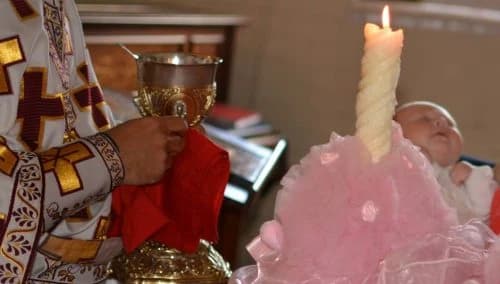
If a child is about to be born into your family, congratulations, may they live long and be saved! I recommend you read the lines below so you know what is truly important, from the Church's perspective, regarding a child's baptism.
Baptism – if I must say it again – is neither a popular "tradition", nor a "magic act", nor a "right" that is automatically due to us, but represents the fundamental act of entering the Church and, consequently, must be received with the respect and understanding due to this Holy Sacrament of the Church.
Do not follow the (often inaccurate) information published on various websites, nor give importance to the multitude of popular customs (some of pagan origin) related to this event: I advise you to guide yourselves primarily by theological (church) ordinances to have a blessed baptism. If you have questions or doubts, do not hesitate to contact me to discuss them together. (Father Ioan-Florin Florescu)
On this page, you will find information, recommendations, and church ordinances about:
Mother, before birth
It is very important that the mother who is about to give birth confesses and receives communion beforehand, so that her child may be born in this blessing. If the mother cannot travel, contact me – I will come to your home. Pray for your child, at least a few minutes a day, and try to keep an atmosphere of peace and joy in the house, which will be transmitted to the child in the mother's womb.
After birth
After the mother and child come home, it is good to call me from the first days to say a prayer of sanctification together. It is your first sanctification in the new family! We will make holy water, pray for the mother's health and the blessing of the house, and (if 8 days have passed since birth) we will read the prayer for "naming the child", their first step into the Church. But, if it is not possible to meet at home, then the father or someone else from the family should come to the church to receive holy water for home, and after eight days (or later, but before baptism) they will bring the child as well, for the reading of the prayers.
Explanation: The ordinance of naming the child on the eighth day after birth is biblical, being mentioned in the Gospel. On the eighth day, the Savior was named: "And when eight days were completed [from birth], for the circumcision of the Child, His name was called Jesus, the name given by the angel before He was conceived in the womb." (Luke 2:21) Why the eighth day? – because, the week having seven days, the eighth day is the symbol of eternity, of the "day" that will never end in the afterlife.
40 days after birth
After 40 days have passed since birth, the mother and child are called to the church for the appointed prayers. Special prayers for this occasion will be read for the mother and she will be able to receive communion, and the child (if not baptized) will be churched, meaning they will be dedicated to the Church, this being their second step towards baptism, after "naming". If the child is already baptized, they will only receive communion, together with the mother.
Explanation: This ordinance at 40 days is also of biblical origin. The Gospel (Luke 2:22) recalls the episode where Joseph and the Virgin Mary brought the child Jesus to the Temple in Jerusalem, being received in the arms of the Righteous Simeon – a feast kept in the Church under the name "The Meeting of the Lord".
Choosing the baptismal name
I advise you to choose a name from the Orthodox calendar for the child, in honor of a saint of the Church. Do not follow the passing fashion of "special" names – fashion goes away, but the names from the Church calendar have been commemorated uninterruptedly for almost 2000 years.
Choosing godparents
The godparent is the spiritual parent of the child. It can be a single person or a family (in fact, even in the case of a family, the godparent is still a single person, the one who makes the confession of faith on behalf of the child). Not only is baptism with multiple godparents (sometimes up to 12, as practiced in some places in the Country) not in the tradition of the Church, but it is even contraindicated, especially in small communities, because spiritual kinship ties are established between the baptized child and their godparents, as well as their families, which will prevent future marriages (from a religious point of view).
The godparent must be an Orthodox Christian: a believer, confessed and having received communion in their church before becoming your child's godparent. A family can baptize a child only if they are religiously married. Do not choose the child's godparent with the thought of material profit or "prestige". Choosing a godparent is similar to entrusting a child for adoption – here it is about spiritual adoption. Do not entrust your child, spiritually speaking, into the arms of a man without fear of God, regardless of their wealth and social position.
Important: In the Edinburgh Parish, as in other Romanian parishes, catechetical preparation (= religious instruction) of the godparent is mandatory. The child's parents are asked to convey to the godparent in time the request to contact me (at church or by email), to provide them with the necessary information.
Choosing the day for baptism
Very important! If, unfortunately, the child is very sick or even in danger of dying, then they must be baptized immediately. Contact me by all means, at any time of day or night, to discuss an "emergency baptism" (which, in great need, anyone near the child can perform).
Baptism can be performed on any day of the year, including fasting days. However, if a fasting day is chosen, it must be taken into account that the snacks or meal offered, usually after baptism, must be fasting food. I recommend you choose the Sunday Liturgy as the moment of baptism (this is the oldest ordinance of the Church). Baptism is performed right during the Liturgy, the highest service and prayer of the Church, when the community is present and participates with its prayer. It is the most suitable moment to pray together for the baptized child, their godparents, and parents.
Mother's presence at baptism
Not only is it permitted, but it is even desirable for the mother to take part in the first great celebration of her child's life. On this occasion, if the prayers from 40 days have not been read to her, they will be read at the entrance to the church.
Service structure
Baptism is performed only in the church and lasts about an hour. During the service, the child will receive Baptism, Chrismation, and Holy Communion. The service consists of:
- Exorcism prayers;
- "Renunciations" (named so from the confession the godparent makes: "I renounce Satan");
- The confession of faith made by the godparent (when the Creed is also recited);
- Sanctification of the baptismal water by invoking the Holy Spirit;
- Anointing the child with holy oil (called "oil of gladness");
- Baptism proper;
- Chrismation (anointing the child with the Holy and Great Myrrh);
- Readings from Holy Scripture (from the Gospel and Epistles);
- Symbolic washing of the child;
- Symbolic tonsure;
- Communing the child with the Body and Blood of the Lord.
Explanations. Exorcism prayers are said over the child because they inherit through their parents, like any human coming into the world, the consequences of original sin (Adam and Eve's disobedience). Renunciations and confession of faith are made by the godparent on behalf of the child (the Gospel itself offers many examples of prayers and confessions of faith made by a parent on behalf of their child). Sanctification of water by invoking the Holy Spirit recalls the sanctification of the Jordan waters at the Savior's baptism. Anointing the child with holy oil (called "oil of gladness") recalls the anointing of "God's chosen ones" (in the Old Testament). Threefold immersion and removal from water is the symbol of death, burial, and resurrection together with Christ. The white cloth is the "garment of righteousness", the "luminous garment" that the baptized one puts on. The candle recalls the light of Christian life, which must "shine before men" (Matthew 5:16), through their deeds. Chrismation in the sign of the cross (anointing with the Holy and Great Myrrh, symbol of the Holy Spirit) is the seal of Baptism, birth "of water and the Spirit" (John 3:5). Tonsure of the child means changing physical appearance, receiving a new face, as a sign of the new life in Christ that is just beginning.
Items needed for baptism
The only items the child's godparent needs to bring to church for baptism are: a simple white cloth (also called chrism, in which the child will be wrapped immediately after baptism), a baptismal candle (I recommend you procure from the church, in time, a natural beeswax candle, yellow, and not a paraffin candle, even if it is white; not the color matters, but the symbol of a sacrifice brought from living nature), a sash (a simple cloth ribbon) and the child's birth certificate. You do not need to bring towels, soap, wine, oil etc. (even if practiced in some places) – in the Church's ordinance such things are not required.
The most beautiful gift the godparent can offer their godchild at this moment is a baptismal cross (also called "baptismal cross"), which will be blessed and offered right during the baptism. Another suitable gift for the baptized child can be an icon. Also, in some churches there is the custom for the godparent to offer the child the first clothes after baptism. Any other things in this sense (bread, gifts etc.) are NOT part of the Church tradition and are not necessary. Rather, do not forget the items necessary for the child's hygiene: diapers, wet wipes, a towel etc.
After baptism
Acquaintances and relatives will assault you with all sorts of customs regarding "ordinances" after baptism: "taking the child out of the myrrh", ritual bath, cutting the hair tuft, ritual cutting of nails etc. None of these customs represent an ordinance provided by the Church. Even immediately after baptism, the child can receive all necessary care for a child, without any special ritual. (For instance, the custom of "taking the child out of the myrrh", the second or third day, at home, by godparents, is a simple popular tradition; the true "taking out of myrrh" is done by the priest himself, during the Baptism service, when he wipes with the sponge the myrrh marked on the baptized child's body.) After baptism, you should have no other care, from a religious point of view, than to pray for your child and bring them regularly to church to receive Holy Communion.
To arrange a baptism or for any questions, visit the Contact. Baptism is usually celebrated within the Sunday Divine Liturgy – see the Service Calendar.